
Best MLB 26 Cards Guide: How Harper and Freeman Change the Ranked Seasons Meta
MLB 26’s multiplayer program has quickly become one of the most impactful content drops in the current ranked seasons ecosystem. With a mix of high-contact hitters, clutch-driven swing profiles, defensive specialists, and one of the most polarizing starting pitchers in recent memory, this program isn’t just about collecting new cards—it actively changes how games are played, especially in high-scoring, comeback-heavy environments.
After multiple ranked season games featuring the new 94 OVR Bryce Harper, 93 OVR Freddie Freeman, Nico Hoerner, Anthony Volpe, and 93 OVR Max Fried, a clear pattern emerges: this drop is built around momentum swings. If you understand how to leverage clutch stats, defensive reliability, and MLB The Show 26 Stubs, these cards can turn even a 7–0 deficit into a winnable game.
This guide breaks down each key player, how they perform in-game, and how to build a competitive approach around them in MLB 26’s current meta.
1. The New Meta Philosophy: Clutch Over Everything
One of the biggest takeaways from this multiplayer program is how heavily MLB 26 appears to value the Clutch attribute. Several of these cards—Bryce Harper (109 Clutch) and Freddie Freeman (109 Clutch)—feel significantly stronger in high-pressure situations than their raw contact or vision stats would suggest.
In practice, this changes gameplay in three ways:
First, late-inning hitting becomes more reliable. Even if your PCI placement isn’t perfect, clutch-heavy hitters consistently produce line drives or gap shots.
Second, comeback potential is dramatically increased. This program is practically designed for “down by five runs” scenarios where one or two swings flip momentum instantly.
Third, pitching mistakes are punished harder. A single missed pitch with runners on base can spiral into a multi-run inning because of how strong clutch swings are.
If you’re building around these cards, you’re not building for consistency—you’re building for explosive scoring bursts.
2. 94 OVR Bryce Harper – The Right Field Power Engine
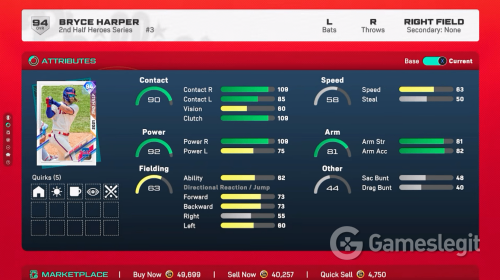
The standout card of the entire drop is undeniably the 94 OVR Bryce Harper. While his defensive profile is slightly awkward, his offensive stats make him one of the most dangerous hitters in MLB 26.
Key attributes:
109 Contact vs Righties
85 Contact vs Lefties
109 Clutch
High power rebound profile
60 Vision (a noticeable weakness)
Despite the lower vision rating, Harper’s swing compensates with elite timing forgiveness, especially when clutch situations activate.
In-game performance:
Harper feels like a pure momentum hitter. When he gets one hit, he tends to snowball. Even off bad PCI placement, he produces hard contact. His most consistent damage comes from fastballs middle-in or middle-out, where his swing path naturally drives the ball into gaps or over the fence.
Defensive usage:
Because his fielding is questionable, many players shift him to right field only, where his arm strength and speed can still prevent extra bases without demanding elite route coverage.
Practical takeaway:
Harper is not a “safe hitter”—he is a game-flipping hitter. If you need one swing to erase a deficit, he is your card.
3. 93 OVR Freddie Freeman – The Most Reliable Bat in the Program
If Bryce Harper is chaos, Freddie Freeman is control.
Freeman’s card might actually be the most consistently productive hitter in the entire set.
Key attributes:
100 Contact
90 Contact vs Lefties
109 Clutch
86 Power vs both sides
Why does he feel elite?
Freeman’s swing mechanics are incredibly forgiving. Even when users are late or early, the ball still finds gaps. More importantly, his exit velocity consistency is absurdly stable.
In multiple-ranked games, Freeman repeatedly delivered:
Opposite-field homers
Line-drive doubles
Clutch two-strike hits
He is the definition of a “keep the inning alive” hitter who still has enough power to punish mistakes.
Meta insight:
Many players underestimate him because his power doesn’t look maxed out—but in MLB 26, swing feel > raw power rating. Freeman proves that repeatedly.
4. Nico Hoerner – The Underrated Glue Piece
Nico Hoerner is not flashy, but he is arguably one of the most valuable utility-style cards in this program.
Strengths:
Above-average defense
Good speed
Solid contact
Reliable clutch hitting
Role in ranked seasons:
Hoerner is a “pressure stabilizer.” When your star hitters are cold or pitchers are forcing soft contact, he keeps innings alive with singles, bunts, and situational hitting.
He also plays excellent defense, turning double plays that directly stop momentum swings from the opponent.
Meta value:
Every strong MLB 26 lineup needs at least one Hoerner-type card—someone who doesn’t try to carry the game but consistently prevents it from slipping away.
5. Anthony Volpe – Gold Glove Chaos Factor
Anthony Volpe’s Gold Glove card is controversial but undeniably impactful in gameplay.
Key attributes:
Elite fielding
High speed
Strong arm
Low contact vs righties (64)
Better vs lefties (88)
Performance reality:
At the plate, Volpe can feel inconsistent. Some at-bats he looks completely overmatched. Other times, he suddenly turns into a clutch hitter.
Defensively, however, he is game-changing. He turns routine ground balls into outs that other shortstops simply don’t reach.
Hidden value:
Volpe’s defensive animations create “rage moments” for opponents. These small defensive wins often lead to offensive frustration, which can snowball into pitching mistakes.
6. 93 OVR Max Fried – The Misleading Pitcher
Max Fried is the most debated card in the entire drop.
Key attributes:
79 H/9 vs Righties
91 H/9 vs Lefties
109 Clutch
Four-seam, curve, slider, sinker, circle change
The issue:
His splits feel reversed in gameplay. Against right-handed-heavy lineups, he struggles more than expected. Against lefties, he performs noticeably better.
This makes him inconsistent in ranked seasons, where most players stack right-handed hitters.
Pitch mix analysis:
Fried’s arsenal is solid, but not dominant. His sinker and slider are his best tools, but without elite velocity or overpowering break, skilled hitters can sit on pitches.
Verdict:
He is a “feel-based” pitcher. Some games he dominates. Others, he gets shelled early.
7. Ranked Seasons Strategy: How These Cards Actually Win Games
Across multiple matches, one pattern stands out clearly: this program rewards comeback baseball.
In one example game, a player overcame a massive early deficit by chaining:
clutch singles
defensive stops
back-to-back home runs
momentum-driven pitching changes
The key lesson is simple: you are never truly out of a game if you have Harper and Freeman in your lineup.
Core strategy principles:
1. Don’t chase early aggression
The best runs come from patience. Walks, singles, and mistakes compound more than swing-for-the-fences approaches.
2. Use clutch hitters in high-leverage spots
Harper and Freeman should bat 3–5 in your order. They are not leadoff hitters—they are finishers.
3. Defense wins momentum
Volpe and Hoerner save runs that directly translate into comeback opportunities.
4. Don’t overtrust Fried
He is better used in controlled matchups, not extended dominance outings.
8. The Hidden Theme of MLB 26’s Multiplayer Program
The most interesting part of this entire drop is not individual cards—it is the design philosophy behind them.
MLB 26 appears to be leaning into:
High variance outcomes
Clutch-driven swings
Defensive animation importance
Momentum-based gameplay shifts
This means games are less about perfect execution and more about capitalizing on 2–3 critical moments per inning.
A player can dominate for six innings and still lose if they fail to capitalize on clutch opportunities. Conversely, a struggling player can come back instantly with one or two perfect swings buy MLB 26 Stubs.
Conclusion: Building Around Momentum Wins Games
The 94 OVR Bryce Harper, Freddie Freeman, Nico Hoerner, Anthony Volpe, and Max Fried represent one of the most “momentum-driven” content drops in MLB 26 to date.
If there is one takeaway from using these cards in ranked seasons, it is this:
You don’t win by being perfect. You win by being explosive at the right time.
Harper gives you chaos power. Freeman gives you stability. Hoerner and Volpe give you defensive insurance. Fried gives you volatility on the mound.
Put together correctly, this isn’t just a team—it’s a momentum engine capable of turning any game around in a single inning.